General Information About the “Human Factors” Master’s Program at JGU
The “Human Factors” master’s program is one of five psychology master’s programs at JGU Mainz. Its official name is therefore M.Sc. in Psychology with a Human Factors Profile. The program consists of 9 modules (A–J). Five modules overlap with the other psychology master’s programs. Three modules plus the capstone module are specific to Human Factors. On this page, you will find an overview of Human Factors-specific modules and courses.
In the module handbook for the Human Factors master’s program, you can find information on psychology modules as well as those specializing in human factors. There are three such modules, comprising a total of seven courses. These are modules E, F, and I.
COURCES (SUMMER / WINTER) AND PLACEMENT OF MODULES WITHIN THE MASTER’S PROGRAM
SoSe 2026
Module E – Fundamentals of Human Factors Psychology
Why do planes crash even when the technology is working perfectly?
Why do people make mistakes that could actually be avoided, and how can
this be prevented through better design?
Human factors psychology places people at the center
of technical systems. In this seminar, you will learn how perception, attention,
and decision-making processes shape interactions with machines, AI, and autonomous
systems—and what this means for the design of safe, user-friendly
technologies. Whether it’s autonomous driving, medical
decision support, or human-robot interaction: human factors
are relevant wherever people and technology intersect.
In addition to theoretical fundamentals, in this course you will actively apply your
knowledge through group work, paper discussions, and interactive
practical examples.
Module F – Human Factors Methods
During the “Human Factors Methods” seminar, the key
methodological approaches in human factors research are systematically presented.
These range from careful study design to observation and analysis techniques
and on to measurement and simulation methods in the laboratory. Accompanying
practical exercises ensure that participants not only
gain a theoretical understanding of the methods covered but also apply them directly themselves.
The focus is not only on the “what,” but also on the “why”: When is
which method appropriate, and how meaningful is it? Over the course of
the semester, students develop a personal toolkit of methods that they can later
draw upon at any time—whether when planning their own studies,
writing their master’s thesis, or critically evaluating others’ research.
Module I – Fundamentals of Applied Cognitive Psychology
How should a robot interact with a human? And what do you need to know about
human perception, cognition, and behavior in order to design such interactions
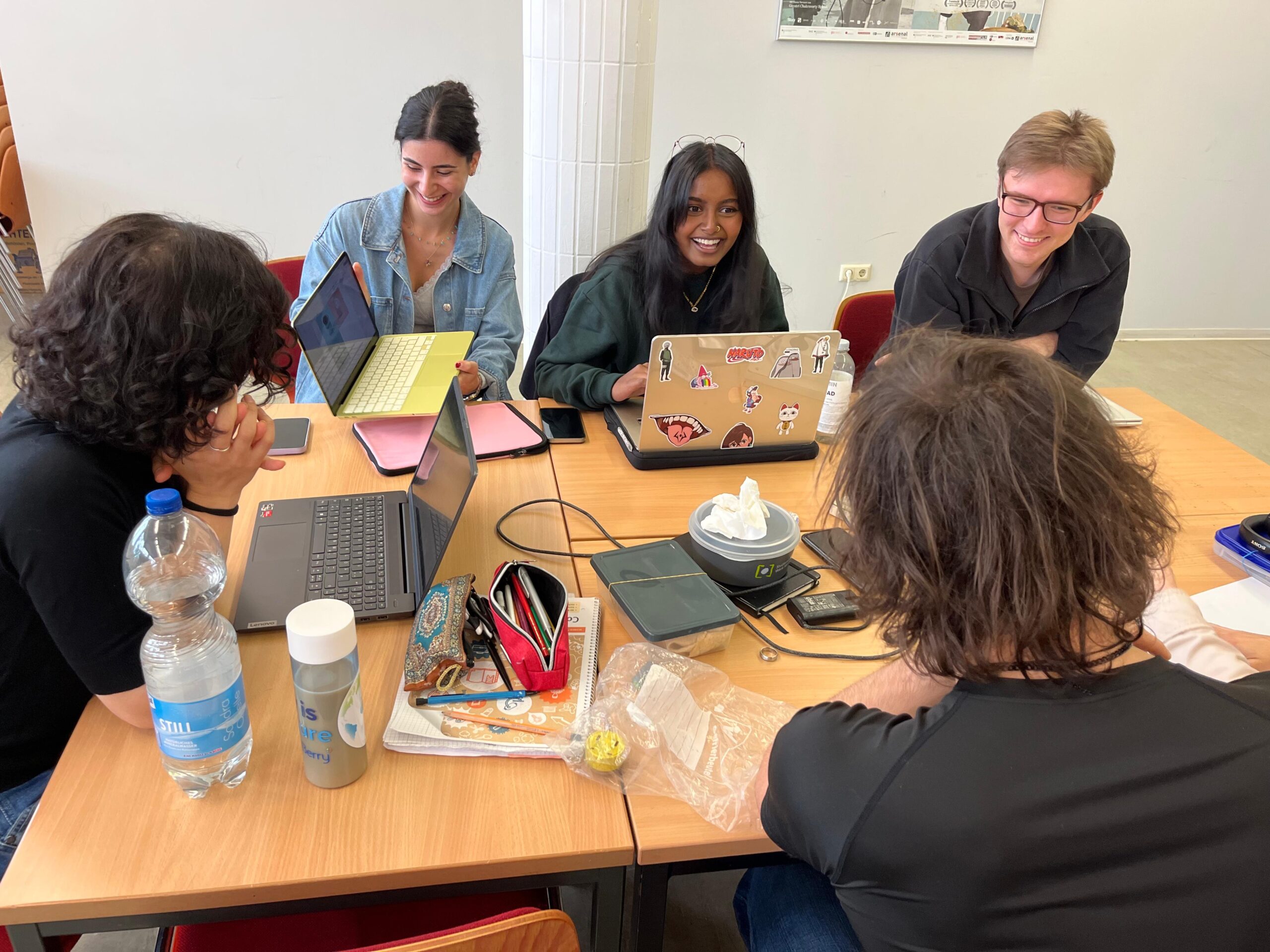
effectively? In interdisciplinary teams composed of computer science and
psychology students, you will explore these questions in the seminar “Fundamentals of
Application-Oriented Cognitive Psychology.”
The focus is on the question of how humans and machines can interact meaningfully
with one another. To this end, you will tackle real-world, societal
issues: You will conduct research, speak with stakeholders, conduct
interviews, and develop your own ideas based on this work. These
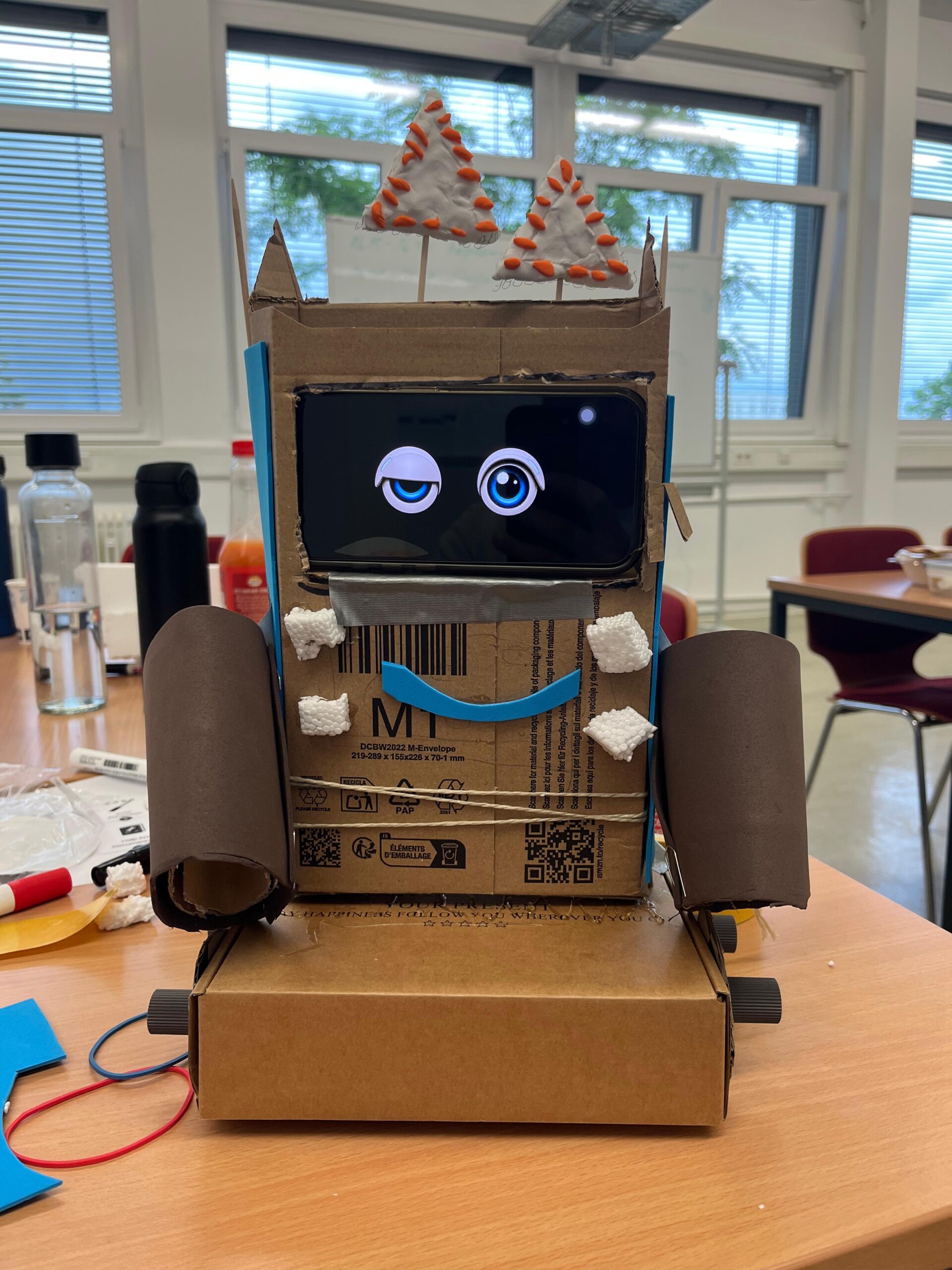
ideas will be gradually transformed into an interactive robotics prototype,
which you will test, evaluate, and refine through multiple iterations. The
seminar not only teaches the cognitive psychological foundations of
human-machine interaction but also practical methods of
human-centered design, user-centered research, and prototype development.
Anyone who wants to know how good human-robot interaction is created will have
the opportunity here to find out exactly that for themselves.

|
|

|
|
Module I – Special Topics in Applied Cognitive Psychology
unknown
WiSe 2026/27
Modul E – Human Factors Design
How should a cleaning robot be designed so that it is accepted in a busy train station
by commuters, children, and blind passersby alike?
In the HF-Design seminar, you’ll explore this question using the methods of the
human-centered design process. From requirements analysis to
personas and prototyping, all the way to usability testing, you’ll go through the
entire design process in small groups and develop your own
interaction concepts.
The seminar combines theory and practice in a project-based format
and teaches skills that are in high demand
in research, industry, and UX design.

Modul E – Human Factors Special Topics
This course addresses current issues in artificial intelligence
from the perspective of human factors and engineering psychology. As
AI systems are increasingly integrated into work processes, education, mobility,
healthcare, and everyday life, the question arises as to
how these systems can be designed to meaningfully support human
capabilities, remain transparent, and
be used responsibly. Topics covered include, among others,
trust in AI systems, transparency and explainability, fairness, acceptance,
and the use of AI in various social and
professional contexts.
The seminar combines the reading, presentation, and discussion of current
academic literature with practice-oriented work sessions in which
AI applications are analyzed, evaluated, and designed as examples. The goal
of the course is to critically assess key psychological and design-related
issues in dealing with AI systems and to apply them to
specific use cases.
Modul F – Project
Intelligent technologies are increasingly shaping everyday life and the workplace.
At the same time, new psychological and social
challenges are emerging, such as mistrust, manipulation, or dysfunctional
forms of human-AI interaction. The “Human Factors” project seminar examines
these phenomena from an engineering psychology perspective.
Students choose their own research topic and develop a
scientifically viable research question based on a
socially relevant problem. Building on this, they design a theoretically sound
study design and address the methodological, practical, and ethical
aspects of study planning.
The focus is on research-oriented work: In addition to developing
a study design, the seminar also covers resource and
budget planning, as well as a critical reflection on the validity and limitations of the
planned study.
Module I – Fundamentals of Applied Cognitive Psychology
unknown
Module I – Special Topics in Applied Cognitive Psychology
Robots are increasingly becoming part of our everyday lives, whether at work, in
healthcare, or in public spaces. But how do people actually
perceive robots? When do people trust them, when do they make people feel uneasy, and what
happens when a robot suddenly displays emotions?
In this seminar, robotics is consistently examined from a psychological perspective.
The focus is on reading and discussing current research.
In addition, the psychological constructs discussed in the literature
will be explored together in a hands-on manner. For this purpose, three robots—some of which are quite
different—are available, ranging from a collaborative robotic arm to a social,
emotionally expressive robot to a walking humanoid.
Examples of topics:
- Humans and Robots: Coexistence, Interaction, and Collaboration
- Trust in Robots and What Happens When They Make Mistakes
- Emotions in Human-Robot Interaction
- Anthropomorphic Robot Design and Its Impact on Perception
-
Personality and Attitudes as Predictors in Human-Robot
Interaction -
Robotics & People with Special Needs (using the example of
people with visual impairments)
The modules specializing in human factors are highlighted in turquoise. With 4 out of 9 modules, they account for slightly less than half of the total. However, in terms of ECTS credits, they make up slightly more than half of the master’s program.
Theses are currently being offered on the following research topics:
- Relationship building in the context of artificial intelligence (AI)
- Accounting for Responsibility
- The influence of introversion and extraversion on attitudes toward artificial intelligence
- Fairness in AI
- Anxiety vs. Trust in the Field of Human-Robot Interaction (HRI)
Are you interested in one of the suggested research topics, or would you like to address your own research question in the field of human factors in your thesis? If so, please feel free to contact us (email: maike.lindermayr@uni-mainz.de).
Are you interested in a research internship in our department or other internship opportunities in industry or research? Then please feel free to contact us (email: maike.lindermayr@uni-mainz.de).
Students in 6th floor, Wallstr. 3, 55122 Mainz You will find an HFI department library with books specifically for the master’s program. You can check the availability of the books at the link below. If you would like to borrow a book, please feel free to stop by Wallstr. 3. You may need to ring the bell outside the glass door on the 6th floor.

